Model-Based Testing EVM networks with Quint and AI

Following the release of Quint Connect , we started using it to set up model-based testing for our in-house projects and today we’re pleased to share the successful story of Emerald and Quint Connect.
Emerald is an open-source framework for building high performance, EVM-compatible networks. It is composed of two major components: the Malachite consensus engine, and the Reth execution client for compatibility with the Ethereum network. Being a crucial software that benefits from rigorous testing, Emerald is the perfect showcase for Quint Connect.
Quint Connect is a Rust library for model-based testing (MBT) that connects a Quint specification with its implementation. With Quint Connect, we can not only ensure that applications implement their specification, but also that specification and implementation don’t diverge over time.
We have experienced challenges before when attempting to bring MBT to an ongoing project due to the cost of writing specifications and the boilerplate code to run model-generated tests against the implementation. This would only make sense in highly critical and stable codebases. In the work reported here, AI has reduced the overall cost of implementing MBT, thus demonstrating that Quint Connect can bring higher test quality to a wider class of systems at low cost.
By formally specifying Emerald in Quint and testing it with Quint Connect, we have helped the team crystallize their understanding about the system properties and invariants, increasing overall test coverage, and ended up finding a memory leak bug.
Emerald’s Quint Specification
A common adoption barrier for MBT is the fact that a lot of applications are not born with a formal specification. That was also the case for Emerald but, luckily, the Quint team at Informal has been actively researching ways in which we can leverage LLMs to assist with the specification of both new and legacy systems.
We started this process by asking AI to read the implementation of Emerald and write a Quint specification for it using the Choreo library. This specification was then refined multiple times to clarify our understanding of the system until we were satisfied with its depiction of how Emerald behaves.
Perhaps the most interesting aspect of Emerald’s specification is that we decided to not model the consensus or the execution engine components. Instead, we have modeled how Emerald behaves when given a consensus input from Malachite as well as how Emerald keeps track of Ethereum’s block lifecycle. This approach reduces state space size while keeping traces focused on Emerald behavior rather than its external components.
Additionally, we have modeled different forms of failures that might affect Emerald nodes in production, such as process restart or data corruption. These failures allow us to verify our model is fault-tolerant, and also provide adversarial scenarios that can be replayed during MBT to ensure the implementation remains correct.
Check out the Emerald specification here . For a quick peek at the modeled inputs and failure cases, take a look at a snippet of the specification’s main Choreo listener below.
pure def main_listener(ctx: LocalContext): Set[Transition] = {
  Set(
    // ...
    // Starts a new consensus round
    choreo::cue(ctx, listen_started_round, handle_started_round),
    // Builds a new block to propose
    choreo::cue(ctx, listen_get_value, handle_get_value),
    // Vote on the proposed block
    choreo::cue(ctx, listen_received_proposal, handle_received_proposal),
    // Decides on the proposed block
    choreo::cue(ctx, listen_decided, handle_decided),
    // Timeout on the current consensus round
    choreo::cue(ctx, listen_timeout, consensus_timeout)
    // ...
  ).flatten()
}
While modeling Emerald in Quint, we have validated three invariants. Most importantly, the agreement invariant states: all nodes agree on decided blocks. This ensures that there are no nodes that commit different blocks for the same consensus instance.
With the Emerald application modeled, we then moved to the implementation of MBT for the codebase.
Model-based testing
After modeling Emerald in Quint, we worked with AI once again to write the boilerplate code necessary to run model-based testing with Quint Connect.
An interesting aspect of having the specification generated from the code is that code and spec ended up at a similar level of abstraction: actions taken by the Quint specification closely map to Malachite consensus inputs. This almost 1:1 mapping between specification and code helped AI significantly while generating the boilerplate that connects Emerald’s specification with its implementation.
Naturally, as with any other AI-assisted coding project, we ended up refactoring and refining the MBT suite to reflect code organization patterns and best practices that we believe make this test suite both understandable and maintainable over time. Nevertheless, AI assistance was crucial to accelerate MBT adoption in the Emerald codebase.
The result is a testing pipeline managed by Quint Connect that uses the Emerald specification as input to generate traces that can be replayed against its implementation via the AI generated test driver.
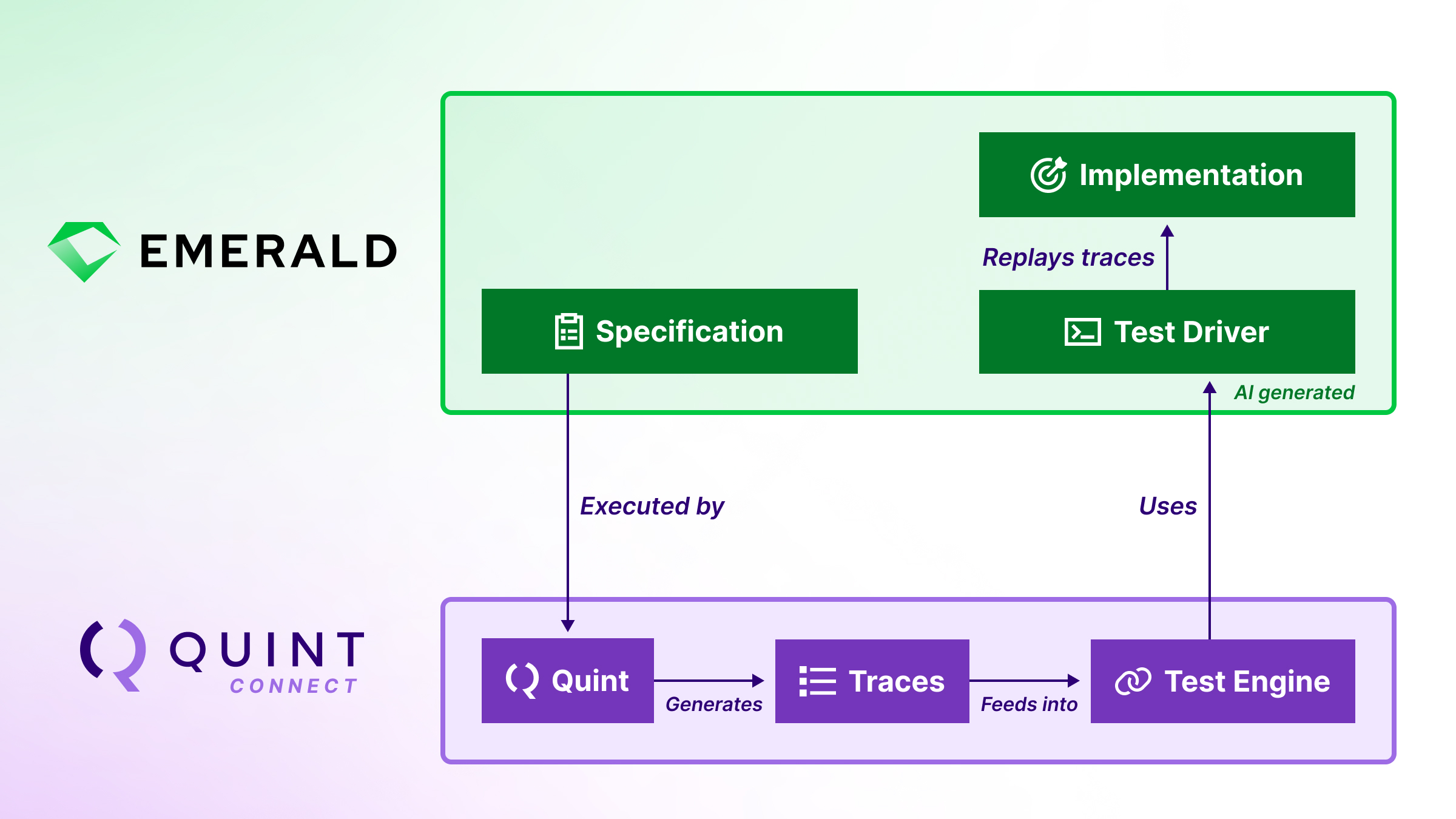
Here’s a snippet of the test driver demonstrating how steps from the generated traces are replayed against the application code:
impl quint_connect::Driver for EmeraldDriver {
    // ...
    fn step(&mut self, step: &Step) -> Result {
        switch!(step {
            InitAction => {
                self.init()?;
            },
            ConsensusReadyAction(node) => {
                self.perform(node, |app, _|
                    app.consensus_ready()
                )?;
            },
            StartedRoundAction(node, height, round, proposer) => {
                self.perform(node, |app, hist|
                    app.started_round(hist, height, round, proposer)
                )?;
            },
            // ...
        }
    }
}
Upon replaying a step from the trace, Quint Connect automatically asserts that the state of the specification matches the state of the implementation. Suffice to define, with the help of AI, the state mapping data structure:
#[derive(Debug, Clone, Eq, PartialEq, Deserialize)]
pub struct SpecState(pub BTreeMap<Node, NodeState>);

#[derive(Debug, Clone, Eq, PartialEq, Deserialize)]
pub struct NodeState {
    pub consensus_height: Height,
    pub consensus_round: Round,
    pub last_decided_height: Height,
    #[serde(with = "As::<de::Option::<_>>")]
    pub last_decided_payload: Option<Payload>,
    pub proposals: BTreeSet<Proposal>,
}

impl quint_connect::State<EmeraldDriver> for SpecState {
    fn from_driver(driver: &EmeraldDriver) -> Result<Self> {
        // AI generated code to extract the application state ...
    }
}
Another area where AI really shines in conjunction with Quint tools is in providing a digestible summary of test failures. Every once in a while we would hit a test failure composed of hundreds of steps. Reading all of Quint Connect’s debugging info could be time-consuming and tedious. Instead, we asked AI to digest the test failure output and generate a Quint run with the exact same steps. We would often ask AI to minimize the test failure by running the test while commenting out unnecessary steps in the Quint run. The result is a minimal and deterministic step-by-step guide to reproduce the failure.
Here’s an example of a Quint run extracted from a test failure that prompted us to refine the specification of how Malachite works in the presence of stale nodes (see PR #202 for details):
run repro =
  genesisStart
    // Node 1 proposes, nodes 2 and 3 decide
    .then("node1".getValue(proposal(1, 0, 0)))
    .then("node2".receivedProposal(proposal(1, 0, 0)))
    .then("node3".receivedProposal(proposal(1, 0, 0)))
    .then("node2".decided(proposal(1, 0, 0)))
    .then("node3".decided(proposal(1, 0, 0)))
    // Node 1 crashes and restarts
    .then("node1".crash())
    .then("node1".consensusReady(1, 0))
    .then("node1".startedRound(1, 0))
    // Node 1 proposes a new value
    .then("node1".getValue(proposal(1, 0, 1)))
    // Node 1 receives the decided value for height=1
    .then("node1".processSyncedValue(proposal(1, 0, 0)))
    // Node 1 now has 2 proposals for height=1 and round=0
    .expect(
      val proposals = s.system.get("node1").proposals
      and {
        proposal(1, 0, 0).in(proposals),
        proposal(1, 0, 1).in(proposals)
      }
    )
    // THIS SHOULD NOT BE ALLOWED!
    //
    // After receiving a value via sync,
    // Malachite will immediately call Decided.
    .then("node1".getValue(proposal(1, 0, 0)))
This process of going from a test failure to a minimal Quint run has helped us find discrepancies between specification and code. The scenarios that were deemed most interesting still live in the codebase in the form of Quint runs that still exercise those behaviors in the form of automated tests via Quint Connect – see the full list of test cases here .
The results
The process of modeling Emerald in Quint sparked some interesting conversations about some of the Malachite semantics and their effect on the Emerald codebase. This isn’t unusual, though. Since Quint specifications sit at a much higher level of abstraction than code, they can often express nuanced behavior in a manner that’s simpler to reason about.
Initially, the MBT implementation found problems that turned out to be known issues. After working through them and refining the model, we ended up uncovering a subtle leak where completed data streams were kept indefinitely, causing the machine to run out of memory eventually – see pull request #178 for details.
Although finding bugs is always a great outcome, we highlight that ensuring conformance between specification and implementation while exercising edge cases both at the spec and code level is the greatest value MBT provides. To that end, we have made the MBT suite part of Emerald’s continuous integration pipeline.
Finally, even though we didn’t aim for complete coverage, the addition of MBT to the Emerald codebase pushed test coverage to about 80% at the application layer. Additional work on model-based tests in conjunction with other testing techniques can improve this number even further.
Try it out
Interested in model-based testing for your project? Check out Quint Connect to learn how to bridge the gap between specification and code. If you’re building institutional blockchain networks, explore Emerald and its formal specification as a reference for how MBT can catch bugs before they reach production.